
Manu Kātene (1898 – 1921)
Served in WW1 as 37771 Private Joe Bird Cotton, NZ Maori (Pioneer) Battalion
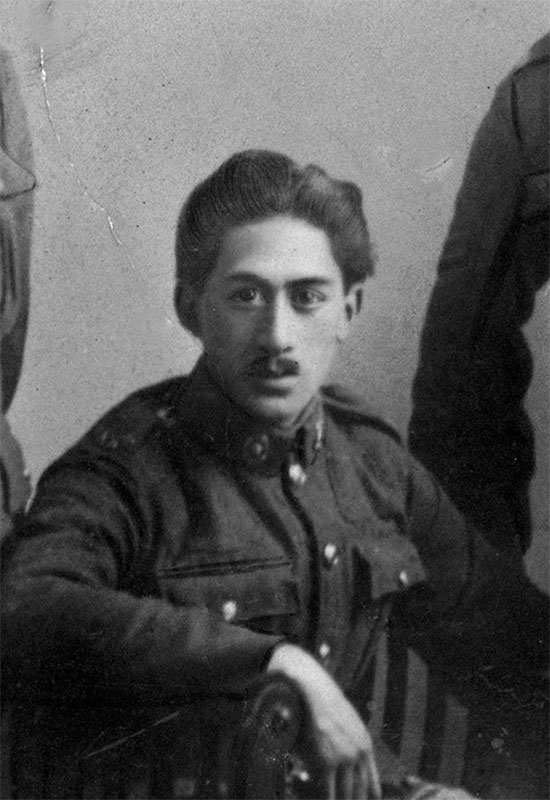
Manu Katene
Manu Kātene was the son of Wiremu and Hareti Kātene (née Atanitu) and one of five brothers who served overseas during World War 1 with the Maori (Pioneer) Battalion.
His attestation form gives his name as Joe Bird Cotton, born in Motueka on 17 August 1896, the son of William Cotton. His year of birth on the attestation form made him the required age of 20 years. However, it is likely that his actual year of birth was 1898. At the time of his attestation he was working as a fitter employed by James Wall of Porirua, and gave his last address as: Wellington Hotel, Molesworth Street, Wellington. He also noted that he was a serving Territorial soldier with the NZ Engineers. His next-of-kin was noted as his brother Harry Cotton who worked at the Native Land Court in Auckland.
Joe attested in Wellington on 12 October 1916 and entered camp at Trentham on 16 October. He remained at Trentham and Featherston until 12 January 1917, serving with both the 22nd and 23rd Reinforcements, when he was then posted to the Maori Reinforcements and moved to Narrow Neck in Auckland. On 14 April 1917 Joe embarked on the troopship Pakeha at Wellington as a member of the 16th Maori Reinforcements, departing the same day but the ship then returned to Wellington on 17 April with mechanical problems. The troops disembarked until 26 April when they re-embarked and sailed for Sydney where the ship was in port for a week. During this time there was a street march through Sydney where the parade was reviewed by the Australian Governor General. Leaving Sydney on 9 May the ship reached Devonport, England on 28 July by way of Fremantle, Durban, Cape Town and Freetown.
On disembarkation Joe marched-in to Sling Camp on Salisbury Plain and was attached to the Reserve Battalion of the Canterbury Infantry Regiment. He left for France on 1 September and reached the Base Depot at Étaples on the 4th. Within a fortnight he moved forward to the NZ Division and joined the Pioneer Battalion on 14 September 1917. On 20 February 1916 the Maori Battalion had been renamed as the NZ Pioneer Battalion and absorbed the surplus officers and other ranks from the Otago Mounted Rifles. Each of the four companies of the battalion would have two platoons of Maori and two platoons of Pakeha. In June 1916 the battalion again changed its organization with two companies of Maori and two Pakeha. There was a fifth company of Cook Islanders who were soon moved back to Egypt as they were unable to cope with the winter conditions in France. This mixed situation existed until the first week of September 1917 when there were now sufficient Maori reinforcements such that the Maori companies were overstrength and the Pakeha infantry battalions were in urgent need of reinforcements. With the posting out of the Pakeha the Pioneer Battalion once again became a full Maori unit and the old name and badge were restored. There is no indication in Joe’s records of where within the battalion Joe was posted so the biography will follow the unit as a whole.
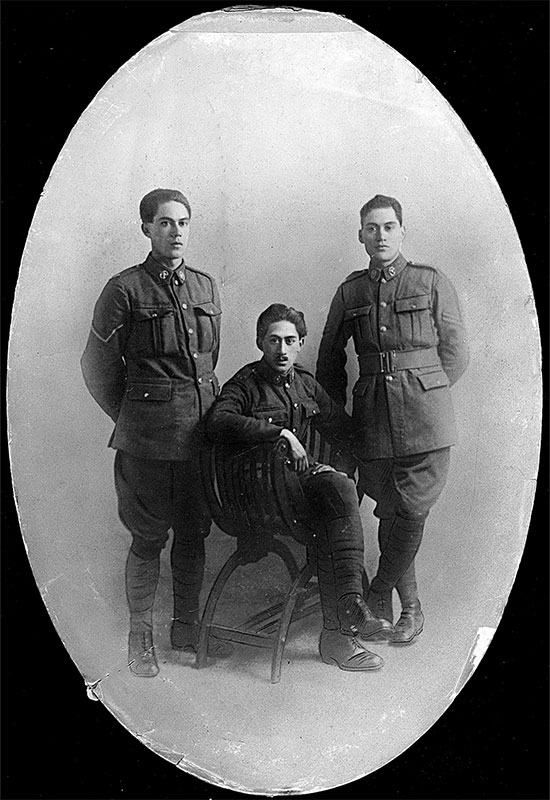
From left Taku Katene, Manu Katene and Hari Katene circa 1919. Sons of Wi and Hariti Katene. Collection of Pataka Art+Museum, Porirua City.
By the end of September 1917, the battalion was in Ypres and engaged in road repairs and an extension to a tramway. During the Passchendaele battles of October the battalion was not directly involved but worked on road repairs and assisted the artillery in getting their guns into position in very wet and muddy conditions. Following a period out of the line in late October/early November the Maori returned to their road repair work and trench construction.
By December the battalion was back in the Ypres area and underwent an air attack on 22 December. The toll was three killed and two wounded. There was equal concern, however, as to whether the pigs and the beer gathered for Christmas had survived. Christmas Day was celebrated with hangis producing a feast that was considered a “dreadful exhibition” with the battalion “relapsing into a more or less comatose state”. On 27 December Joe was evacuated to the Field Ambulance with a “Pyrexia of Unknown Origin (PUO)” which was the diagnosis for someone with a fever but presenting no other symptoms. By 5 January 1918 Joe was back with his unit.
The unit, still in the Ypres area, was heavily engaged in trench, road, and light railway construction and battlefield salvage. The battalion remained in Ypres with the trench and wiring work continuing and strengthening of one of the strong points until 21 March when word was received of the German offensive towards Albert and Amiens. The following day the unit was on the move south, Joe, however, was not with the unit. Once again, on 22 March, he was admitted to the medical system with a PUO where he remained until 30 March when he marched-in to the Base Depot at Étaples remaining until 10 April when once again a PUO struck. It was 27 May when he returned to Étaples following time in hospital and at a Convalescent Depot. Joe returned to the Maori Battalion on 6 June 1918.
The battalion was now in the Colincamps – Hebuterne area in northern France engaged in the usual activity of trench repair and wiring. Work was carried out in the mornings leaving the afternoons for sport. Trench and tramway tasks continued, but for Joe the war ended on 14 August when he was once again admitted to the medical evacuation system. By 18 August he was admitted to a hospital and diagnosed with Debility. This was a catch-all expression for soldiers who were suffering from multiple conditions including stress. Five days later he was evacuated to England in the hospital ship Breydal and admitted to the New Zealand hospital at Walton-on-Thames with the diagnosis of Mild D.A.H. This is the abbreviation of Disorderly Action of the Heart, a term that was used during World War 1 to indicate that a soldier was suffering from stress and had nothing to do with his cardiac system. By 21 September his records note, “Complaint now diagnosed as War Psychosis”.
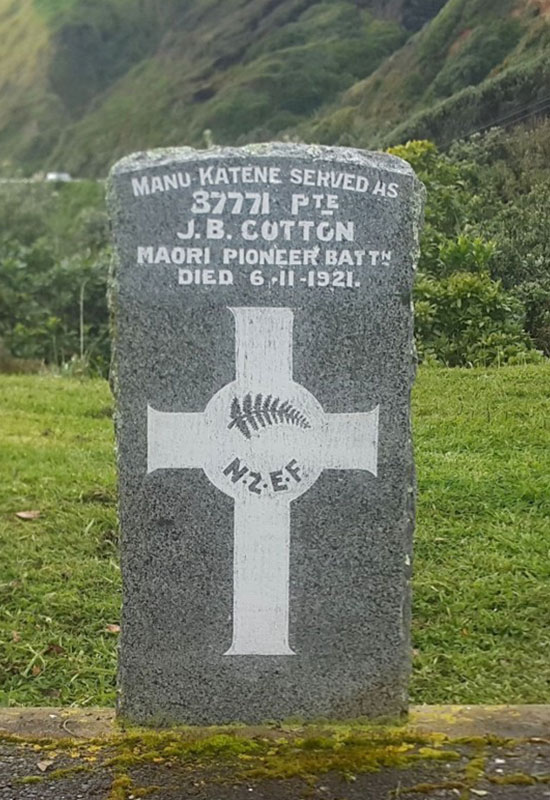
Grave of Manu Katene at Katene urupa, Pukerua Bay. Photo Terry Brown.
Joe remained in the hospital system until 5 October and following a period of leave moved to Codford Camp and then onto Boscombe in the Bournemouth area and the Reserve Depot for the NZ Engineers. There is no explanation for his time at either camp. On 10 January 1919 Joe moved to Larkhill and rejoined the Maori Battalion. While at Larkhill he was medically examined on 24 March by Dr Peter Buck (Te Rangi Hīroa, later Sir Peter Buck) and signed off in good “health or physical condition”. The unit embarked at Liverpool in the troopship Westmoreland for the return voyage to New Zealand; a direct voyage via the Panama Canal. Joe disembarked in Auckland on 6 April and was discharged from the Army “on termination of period of engagement” on 4 May 1919.
Joe’s death certificate states that he died on 6 November 1921 at “Trentham Military Hospital From Porirua” of “Exhaustion” resulting from “Pulmonary Tuberculosis – 3 years”. There was no impairment of health or physical condition and his health and physical condition were assessed as good in March 1919. Yet he had had pulmonary TB for three years prior to his death. His occupation was recorded as “soldier”, yet he had been discharged on 4 May 1919. There was no suggestion of a medical condition in his discharge statement.
Manu Kātene is buried in the Kātene Urupa at Pukerua Bay and he is also remembered on the Titahi Bay RSA memorial.
For his service with the Maori (Pioneer) Battalion in France Joe received the:
British War Medal 1914-19, and Victory Medal.
As Joe died prior to the issue of his medals they were forwarded to Isabel Kātene, wife of Joe’s brother Hari Wi Kātene.
Thanks to the Kātene whānau
By Terry Brown
Post script:


