
Horace and Norma Ames, Pukerua Bay Storekeepers
The Ames Family – whalers and early settlers
Horace Ames lived in Pukerua Bay from 1909 to 1939. He was a grandson of the whaler James Ames. James was trading in New Zealand waters from 1838 to 1839 and in 1840 he established a whaling station on Kāpiti Island. In 1843 he set up a second station at Kaikōura.
James Ames was born in 1808 in Sandridge, Hertford, England and married Mary Ann Hull in Sydney in 1838. Mary Ann, born in Sydney in 1817, was the daughter of John Hull, a licensed victualler who had arrived in New South Wales in 1814 on the Windham, and Judith Caffrey, a convict from Ireland. James Ames was the master of a schooner which traded between Sydney and the west coast of New Zealand. In 1839 James arrived at Kāpiti on the Star of China and was later the chief mate on an English whaler, Caroline.
In 1842 James and Mary and their first two sons were living on Tokomapuna Island just off Kāpiti. James believed his family would be safer there than on Kāpiti itself or the mainland. One day when Mary, her sister and the small children were alone they watched Te Rauparaha and Te Rangihaeata come on to the island and then request food. The two women quickly “placed a meal before the hungry warriors.” (Evening Post, 22 November 1887, p2)
Between 1844 and 1848 James was whaling from stations at Port Cooper (Lyttelton) and Kaikōura.
The New Zealand Spectator and Cook’s Strait Guardian on 22 February 1845 reported the success of the shore whaling parties during the 1844 season. James Ames, with 4 boats and 30 men, had won 28 tons of whale oil and 1 ton of bone. On 7 July 1847 the Wellington Independent advised that, “Mr. Ames left for this port, in an open boat, some fifteen days ago, to procure supplies for his party, and as he has not since been heard of, apprehensions are entertained for his safety.” The follow-up on 10 July noted, “Mr. Ames arrived safe in port yesterday having been into Cloudy Bay.” (Wellington Independent, 10 July 1847, p2)
In 1848 James was appointed temporary pilot for the Port of Wellington pilot station based at Lyall Bay. He later became a hotelier at the Rose Inn, Lower Hutt. A report in the Wellington Independent on 5 January 1850 of the New Year’s Day celebrations said, “The valley of the Hutt was completely overrun with visitors. The Odd Fellows commemorated the anniversary of the Rose of the Valley Lodge, at Ames’ and we need scarcely say that the jolly host did all in his power to make all parties comfortable”. By February 1850 James was at the South Sea Hotel on Lambton Quay, Wellington. Captain James Ames died aged 42 on 17 October 1850 and is buried in the Bolton Street Cemetery.
From 1853 the license for the South Sea Hotel was held by Mary Ann Ames. However on 23 January 1855 the brick hotel was “thrown down” in the magnitude 8.2 earthquake which rocked the southern part of the North Island. It was the most powerful ever recorded in New Zealand. https://teara.govt.nz/en/artwork/4389/wellington-in-the-1850s
Mary Ann Ames then became the proprietor of the Ames Arms Hotel on the Porirua Road, Johnsonville. In 1856 Mary married George Ashdown who had been a whaler in Taranaki and then a storekeeper and publican in Wellington. George died in 1858 and is buried in the Bolton Street Cemetery.
Mary Ann died at the Wellington residence of her son James Ames, the City Valuer, on 21 November 1887 and is buried in the same plot as her two husbands in the Bolton Street Cemetery.
Mary Ann’s obituary in the New Zealand Times on 22 November 1887 concluded with, “She was a fit woman to be an early settler’s wife; full of untiring energy, blessed with splendid health, and always carrying a high and cheerful heart, she overcame all difficulties. Her hospitality, geniality, and general kindness will long be remembered by those who had the pleasure of knowing her.” (New Zealand Times, 22 November 1887, p4)
Mary Ann and James Ames had six children: two sons, George born in 1838 and James born in 1840 were both born in Sydney; daughter Emma was born in 1844 at Tokomapuna, Kāpiti Island, son Joseph was born in 1844 at Kaikōura; and Horace born 1847 and William born 1850 at Wellington.
Horace Ames (1847 – 1927) was living at Johnsonville on the Porirua Road in 1875 when he married Ellen Louisa Hughes (1849 – 1914) in St Paul’s Pro Cathedral, Thorndon.
Horace Ames held the license for the Provincial Hotel in Upper Hutt in 1876, then for the New Town Hotel, Riddiford Street, Wellington followed by the Panama Hotel in 1881. The family then moved out to Paekakariki where in 1891 Horace was elected on to the school committee. In 1902 he was referred to as a “well known settler of Paekakariki”.
Horace and Ellen Ames had seven children: Maud Jannette (1876), Horace (c1878), Ida Emma (1879), Alice Mary (1881), John (1882), Herbert (1885) and Percy (1888). The next few years were a busy time as their three daughters and two sons married between 1902 and 1907. They later moved to Essex Street in Plimmerton. Ellen died in Plimmerton on 17 September 1914. Horace snr of Plimmerton died on 25 September 1927.
Horace and his brother John are noted in the 1905 Electoral Roll as farmers, Pukerua. They were sheep farmers on land in the name of many Maori families including Raiha Waitohi Puaha. Raiha was married to Joshua Henry Prosser in 1877 and they lived at Takapūwāhia where they built their horse racing empire.
Joshua developed a love of horses both as a jockey and then as a renowned racehorse trainer. He began his racing career as a Jockey on Parumoana flats and won his first race on a horse called Pamau in 1866 when he was only 15 years old.
In 1910 Joshua Prosser purchased 96 acres of Pukerua 3C No.1 D from Eruera Tungia at the agreed price of £679. This was the land where Horace was sheep farming. From 1909 the Parliamentary papers reported the Annual Sheep Returns which included the farmer’s name and location. That year Horace was recorded owning 300 sheep and by 1914 the number had risen to 707 but in 1919 the number was Nil. https://paperspast.natlib.govt.nz/parliamentary/AJHR1919-I.2.2.4.33
On 21 February 1906 Horace Ames married Joshua Prosser’s niece Norma Bessie Bradey. Norma Bessie Bradey, was born at Duck Creek, Pāuatahanui on 5 April 1882. She was the daughter of Alfred James Bradey (senior) and Elizabeth (Lizzie) Bessie Prosser. Her great grandfather, Francis Elezious Bradey, arrived in Wellington in 1840 and purchased 2,000 acres at Duck Creek, Pāuatahanui.
The Evening Post described the wedding in detail although the reference to Horace Ames as “well known in athletic circles” is questionable. Newspapers are an excellent source of day-to-day information but there is an H. Ames who is mentioned in Canterbury papers as a champion in NZ Amateur Athletics & Cycling events at the same time.
At St. Alban’s Church, Pahautanui, on Wednesday last, Miss Norma Bessie Bradey, eldest daughter of Mr. Alfred Bradey, was married to Mr. Horace Ames, farmer, of Paekakariki, well known in athletic circles. The service, a choral one, was largely attended, and was conducted by the Rev. Vosper. The father gave away the bride, who was handsomely dressed in pearl satin beautifully trimmed with Limerick lace, with bridal wreath and veil. The bridesmaids numbered five, all dressed in cream silk, with blue chiffon hats, and wearing gold brooches, the bridegroom’s gift. Messrs. S. Kent and W. Buck attended the bridegroom. The “Wedding March” was played by Miss Steele, of Johnsonville, as the party left the church, and a reception was held subsequently at the residence of the bride’s parents, where a sumptuous breakfast was served and the usual toasts were honoured. (Evening Post, Ladies’ Column, 3 March 1906, p15)
Horace and Norma at Pukerua – “Mrs Ames was my greatest friend…”
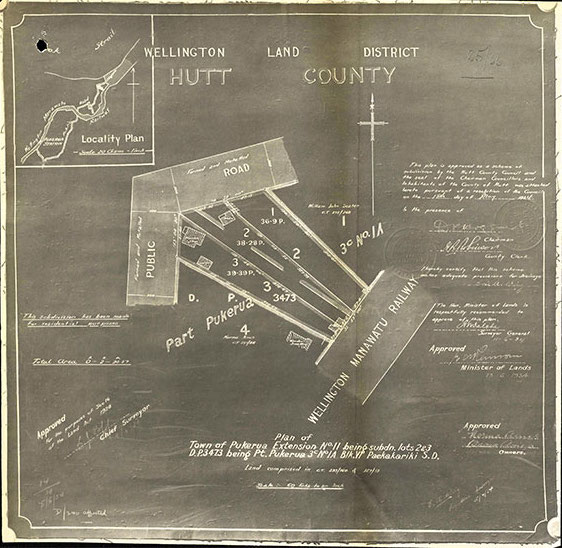
Plan of Extension 11. Pt 3c No 1A Blk VI Townships – Pukerua, R21030937, Archives New Zealand Te Rua Mahara o te Kāwanatanga
Horace and Norma settled in Pukerua close to the railway line on the bluff overlooking what is now called Brendan Beach but also looking across to Kāpiti and Tokomapuna islands. Maybe Horace had heard stories from his grandmother Mary Ann about her early days at Kāpiti.
While Horace was employed in farm work Norma set up the Pukerua Cash Store. The Prosser land which Horace Ames was faming and where he and Norma made their home was then purchased by Charles Gray. In 1917 Norma Ames purchased from Gray Lots 2, 4 and 7 on Plan 3473 (Certificate of Title Under Land Transfer Act Vol 180 162). At this time Charles Gray was securing significant land in the Pukerua, Waimapihi and Wairaka Blocks. In 1919 his brother-in-law Arthur Lindsay, on his release from the army, came to Pukerua to work for Gray. It cannot have been easy for Horace and Norma Ames when Gray set Lindsay up in a rival store.
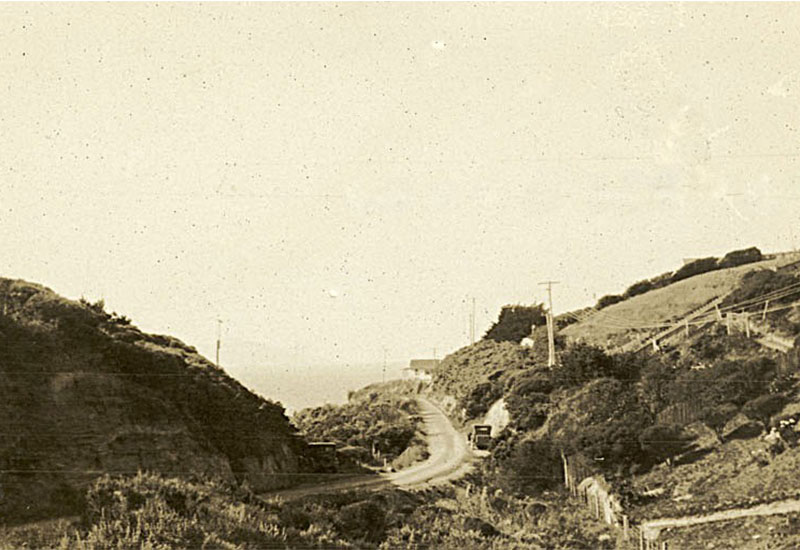
Looking on to Ames Store which was also the Post Office c 1936. Photo: Coveney Album Pataka Art+Museum
There were ninety steps from their home close to the railway down to the store on the bluff. Norma supplied provisions for the weekenders and the few permanent residents. If there was no one in the store when a local popped in, they just left a note of what they had taken and paid later. Horace carried bags of sugar and flour on his back along the railway line from the station to the store. When the earliest and smallest stretch of internal road opened in the Bay Horace brought the first car to Pukerua. He drove along the line “at a great bat until he could turn off onto the one small piece of usable road between the line and store. He never met an oncoming train, confident that he would know when the next train, one of a few, would be due along the single track”. (Kay, Barbara. (1996). Anthony Wall, Settler of Porirua, p106)
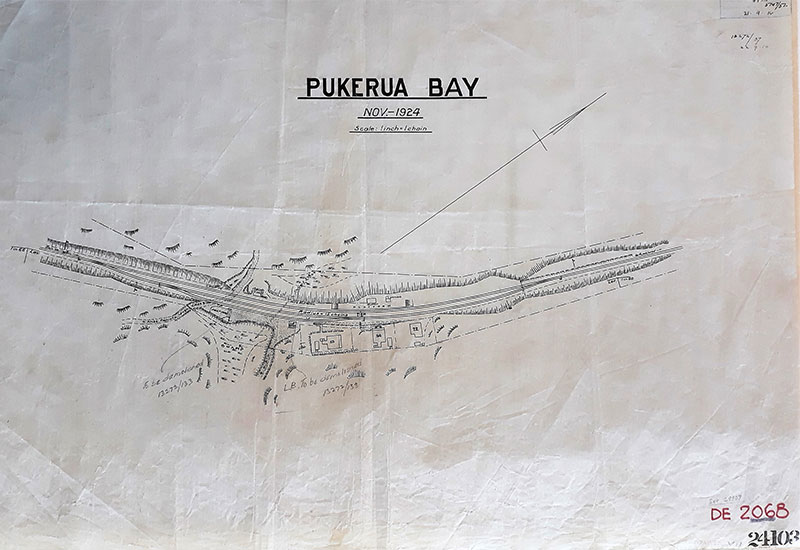
NZ Railway plan of Pukerua Bay station 1924. R25540074. Archives New Zealand Te Rua Mahara o te Kāwanatanga
A post office was also part of the cash store. Known as the Waimapihi Post Office it opened on 11 July 1919 with Winifred Bullock, wife of a railway porter, as the postmistress. In 1921 Norma Ames took over the position of Postmaster and at this time the New Zealand Gazette announced the change of name from Waimapihi Post Office to Pukerua Bay Post Office.
The residence of H. Ames was a polling place for Parliamentary elections and Licensing Polls. Horace was a farmer but also carried out other local work. In August 1914 the tender of Mr H. Ames at £7 per chain was accepted for work on the Plimmerton-Pukerua road.
In 1918 only a handful of farming, Māori and railway families lived at Pukerua. Clara and Frank Linney lived at Pukerua from 1915 to 1923. Frank was a tablet porter for the New Zealand Railways Department. The tablet system was a safety measure which allowed only one train on a particular section of track at any one time.
The Linney family lived in railway house No. 53 which they rented for seven shillings per week. Clara later wrote of their life at Pukerua:
We were fairly isolated, but the few of us who lived there were a happy little band. When we got the tennis court we thought we were just it. It was very rough around the edge. One day I sprained my ankle falling down in it and had to be wheeled in a wheelbarrow home, up the railway track to the station.
I could write a book about Mr & Mrs Ames. Mrs Ames was my greatest friend…. They were the happiest days of my life. November 15, 1915 was the exact date I first saw Pukerua. I could never forget it. (Blair Collection, Personal correspondence, 26 May 1977)
When Norma went to visit her mother it was regarded as a significant event; “Mrs. H. Ames, of Pukerua, is visiting her mother, Mrs. Alfred Brady, at Pahautanui” from the “Women in Print” column of the 16 February 1918 Evening Post (p9). Another antidote to loneliness must have been reading and she very soon set up a lending library. Most of the forty books passed on to He Ara are numbered and stamped Pukerua Cash Store.
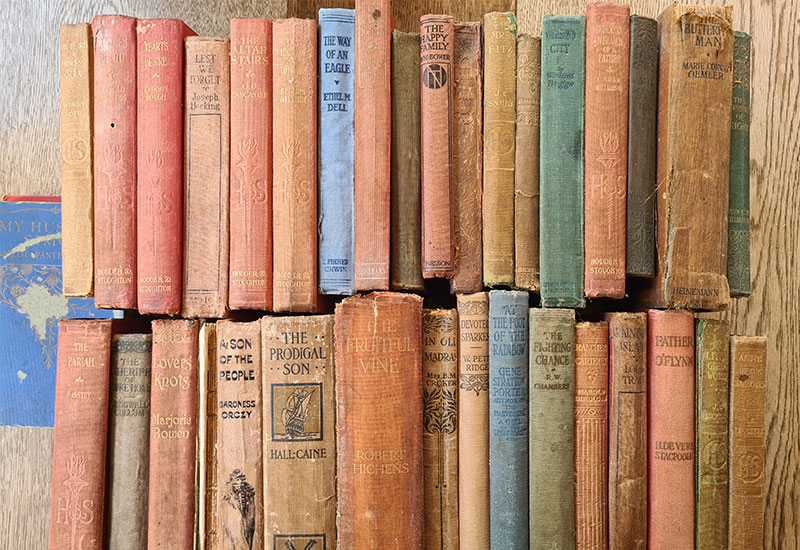
Books from Norma Ames Library. Titles include: Father O’Flynn by H. de Vere Stacpoole, and The Sheriff of Dyke Hole by Ridgwell Callum
Horace was very vocal about the state of the Paekākāriki Hill Road and road access to Pukerua. The Evening Post reported on 10 September 1919, “It was a matter for the Government to undertake to have the route made through Pukerua. Mr. Ames also pointed out that the money being spent on the Paekakariki Hill-road would cover the cost of the whole of the proposed deviation work, which they suggested. He asked if the estimated cost had been obtained.” (Evening Post, 10 September 1919, p4)
In the late 1920s with easier access and the popularity of Pukerua Bay for a weekend excursion the Ames opened a small store on the beach which supplied hot water and ice cream among other provisions so picnickers would not need to make the climb up to their store on the bluff. During the 1930s Horace kept a dinghy down on Brendan beach which he would hire out at a shilling an hour.
Horace and Norma’s son Noel Alfred had been born on 16 December 1906 and their daughter Norma Phyllis on 26 June 1908. A third child died at birth in 1910. The children travelled by train to Plimmerton School where Phyllis gained her Proficiency Certificate in 1921.
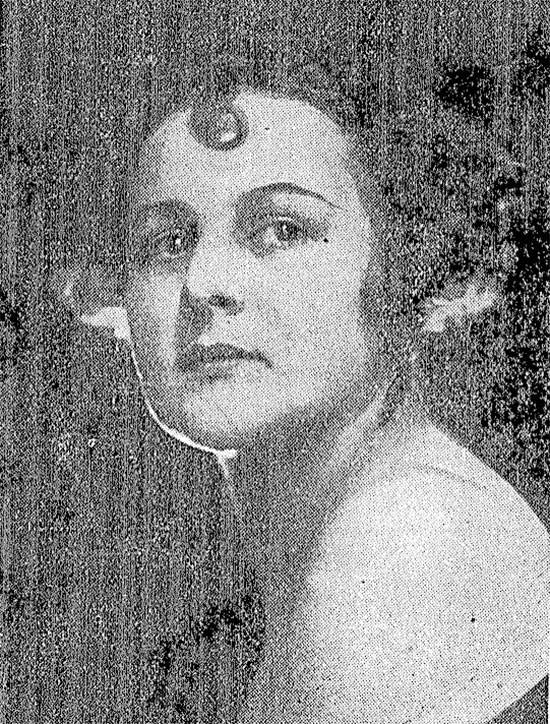
Miss Phyllis Ames, Wellington contestant in the Miss New Zealand Beauty Contest. Photographer S.P. Andrew Studios. Dominion, 11 October 1926, p.6
Phyllis would have enjoyed the company of the Henderson family who were frequent visitors to their beach homes from the early 1920s and also their near neighbours Mabel and Grace Coveney.
During October 1926 the country was in a frenzy as provincial finalists were announced for the Miss New Zealand Beauty Contest. Phyllis Ames was one of twelve finalists in the first round of voting. The competition was promoted by the Dominion newspaper.
Phyllis Ames was mentioned in the Evening Post on 27 August 1930 as one of the 300 guests at the Plimmerton Bowling, Croquet, and Tennis Club annual ball held in the Taupo Hall.
Topics for Women – Successful Function, Plimmerton Annual Ball
The Plimmerton Bowling, Croquet, and Tennis Club held its annual ball in the Taupo Hall, Plimmerton, recently. There were nearly three hundred guests present, including visitors from Hawkes Bay, Taranaki, Manawatu, and Wellington, and all previous attendance records were exceeded. The decoration of the hall was carried out on spectacular lines, long lines of coloured electric lights being hung with lycopodium and lanterns immediately above the dancers’ heads. Native ferns gave a delightful appearance to the walls and the orchestral platform, the interior as a whole being completely transformed. (Evening Post, 27 August 1930, p13)
Sadly, Norma Phyllis died on Anzac Day 1931; the cause of death was given as hydatid disease of liver. (Te Tari Taiwhenua, Internal Affairs, Death Certificate 30 June 1931)
Hydatids can infect humans, sheep and other animals, and is contracted from dogs which carry the hydatid tapeworm Echinococcus granulosus. The larvae are parasites that form cysts in the organs (especially the liver and lungs) of livestock and people. In humans, hydatid cysts cause illness and occasionally death. Dogs get the parasite when they eat offal from infected livestock and so offal must be cooked before it is fed to dogs. The National Hydatids Council worked for 45 years to rid New Zealand of the parasite through education, and control of dogs. It was crucial for all dogs – family pets and farm dogs – to be taken to the local dog dosing strip. In Pukerua Bay this was along Muri Road.
Both Phyllis and her mother Norma were both issued with Motor Driver’s Licences in early 1931.
Horace and Norma’s son Noel joined the New Zealand Division of the Royal Navy on 12 February 1924 on a 12-year engagement. Prior to this he was living in Pukerua Bay and employed as a warehouse boy. He was posted to HMS Philomel, a decommissioned cruiser berthed at the Devonport Naval Base, Auckland. On completion of his basic training NZD 598 Noel Alfred Ames joined HMS Dunedin, one of the Navy’s two sea-going cruisers. He was promoted to Able Seaman on 12 March 1926. In 1927 the Dunedin was in the UK undergoing a refit. Noel then joined HMS Vernon, the Royal Navy’s shore-base for mine, torpedo, and electrical training, where he remained until March 1928. On 3 March 1928 he joined HMS Tiger, a battlecruiser employed as a gunnery training ship. Noel then joined HMS Diomede, a cruiser of the Royal Navy, which was also in the UK for a refit. On 31 December 1929 he joined HMS Hawkins, a heavy cruiser serving with the Atlantic Fleet. He rejoined the Diomede following her refit and returned to Auckland in December 1930.
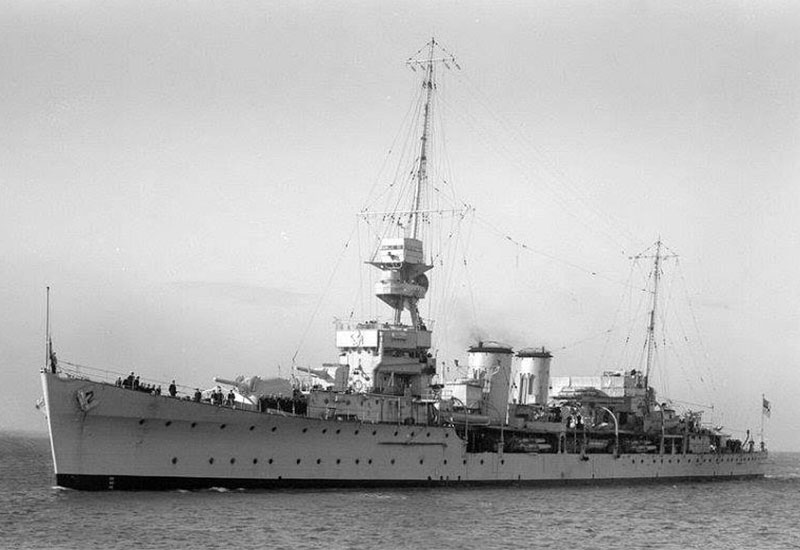
HMS Diomede. https://www.facebook.com/GreyFunnelLine
In March 1931 the Diomede, along with her sister ship Dunedin, was one of several ships sent to give assistance at Napier after the devastating Hawkes Bay earthquake supplying medical personnel, equipment, guards and firemen. The Ames, Wall, Lindsay and Gray families all made contributions to the nation-wide Hawkes Bay Earthquake Relief Fund.
During 1931 and 1932 the Diomede completed the annual cruise through the Islands, arriving back in Auckland on 26 August. Noel appears to have completed a period of leave and then returned to the Diomede which was to carry out a programme of gunnery exercises, including night firing in the Haruaki Gulf. At this time Noel was apparently troubled about a relationship with a young woman in Wellington. On 10 September 1932 Noel committed suicide by shooting himself. His file contains the traditional letters “DD”, standing for Discharged Dead, as the final notation. (Auckland Star, 10 September 1932, p10, Coroners inquests – Case files – Auckland – Ames, Noel. R23857786. Archives New Zealand Te Rua Mahara o te Kāwanatanga.)
This was the third family tragedy for Norma and Horace Ames.
Life continued at Pukerua Bay for Norma and Horace. In 1934 Norma Ames organised a dance to raise funds for the Free ambulance:
FREE AMBULANCE – PUKERUA BAY EFFORT
A very successful social and dance at Pukerua Bay recently, resulted in a contribution of £17 being given to the funds of the Free Ambulance Association. The large attendance showed that the residents were in support of this worthy object. Several gave money contributions.
The function was organised by Mrs. Ames and a committee of ladies acting on behalf of the Ratepayers’ Association.
Mrs. Ames’s jazz orchestra provided the music for the dancing, and a concert party consisting of Messrs. J. Mountjoy, jun. (organiser), L. Warner, M. Pearce, and Misses M. Davis, G. Henderson, and H. Henderson provided very enjoyable song, dance, anil elocutionary items. Mr. Pearce was accompanist.
In opening proceedings on behalf of the ratepayers, Mr. H. Mayer said that the Bay was greatly indebted, as was the whole Wellington district, to the Free Ambulance.
Mr. R. L. Button, councillor for the riding and a member of the Free Ambulance executive, and Superintendent Roffe gave some interesting information about the organisation of their association. It had the approval and active- support of all branches of the community as was shown by the large attendance at this and other similar functions.
An excellent supper was provided by the committee of Pukerua ladies.
(Evening Post, 21 February 1934, p13)
Wellington Free Ambulance was founded by the mayor of the day, Sir Charles Norwood in 1927. The £17 raised in 1934 is equivalent to $2598 in 2024.
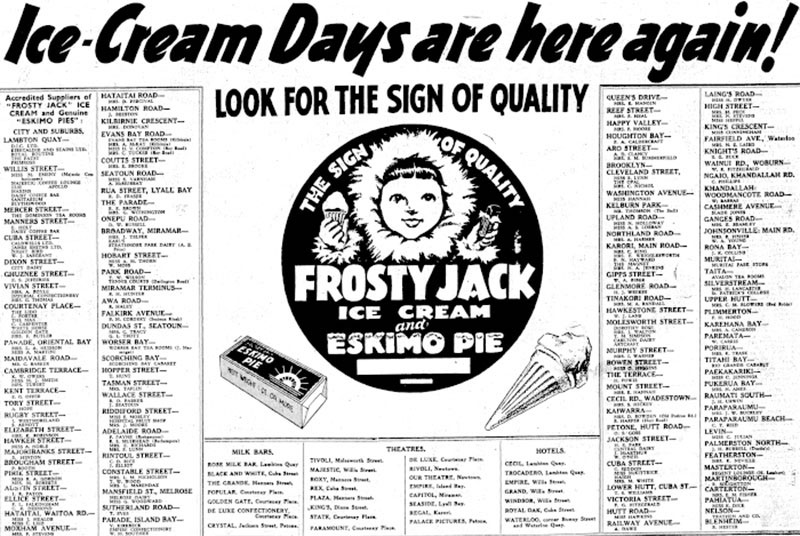
Evening Post, 10 November 1937, p21
An advertisement in the Evening Post in November 1937 listed Norma Ames as one of the accredited suppliers in Wellington of Frosty Jack Ice-cream and Eskimo Pies. First produced in New Zealand in 1924 the Eskimo Pie was described as “the chocolate ice-cream confection that has taken the world by storm, guaranteed pure and wholesome.” (Evening Post, 10 November 1937, p10 and https://www.historyicecreamnz.co.nz/frosty-jack.htm
Following the opening of the Paremata Bridge in 1936 work began on building the new highway from Plimmerton to Paekākāriki. In September 1937 Horace Ames had the forethought to make an application in accordance with the Industrial Efficiency Act 1936 for a licence to “install one petrol pump at applicant’s store, Pukerua Bay”. His application was declined. (The New Zealand Gazette, 14 October 1937, p2349)
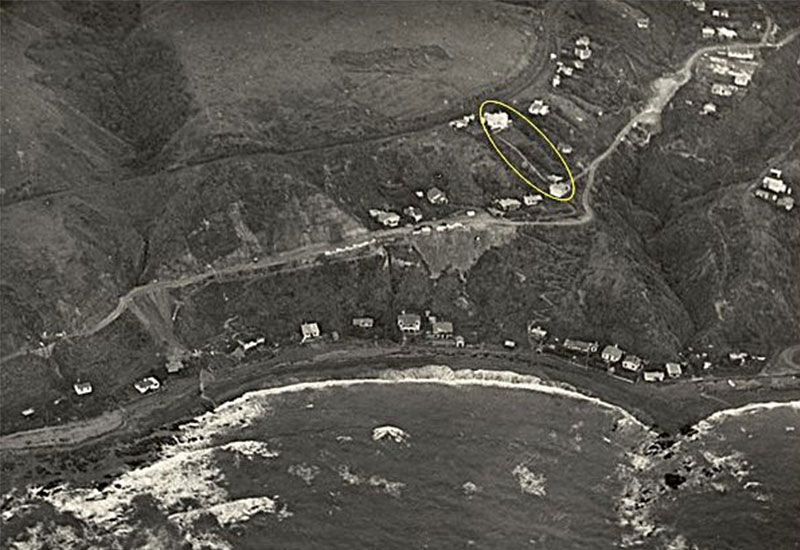
Ames home and store 1937. Photo: Coveney Album Pataka Art+Museum
The construction work brought about many changes in Pukerua Bay especially in the northern area of the Bay. The next blow for the Ames was the forced removal of their store to make way for excavations for the new road. By this time Horace and Norma must have felt dispirited, and they retired to Raumati Beach.
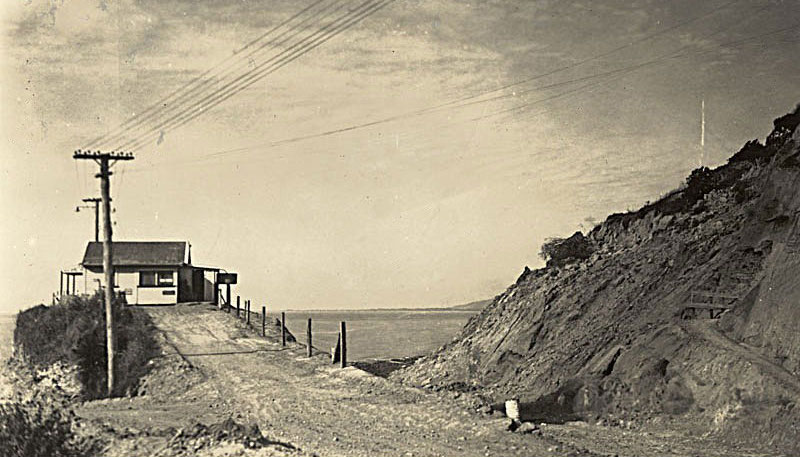
Ames Store, December 1938
Horace died on the 24 May 1945 at Raumati Beach. Horace and his two children are buried in the St Alban’s Burial Ground, Pāuatahanui. Norma continued to live in Raumati and on 2 June 1967 she married Eric Henry Nielsen. Norma, aged one hundred years, died on 13 September 1982 in the Continuing Care Unit Paraparaumu Hospital. Norma is buried in Paraparaumu Cemetery.
Dorothy Challies née Henderson, a friend of the Ames family wrote at the time of the Pukerua Bay School 50th jubilee in 1977 “I do hope the Ames family have not been left out of the story. They were fine but terribly unfortunate people.”
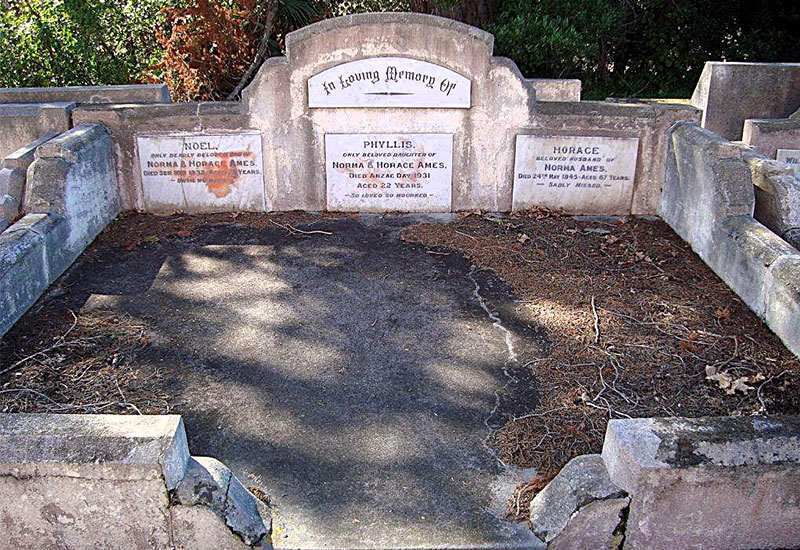
Ames Family Plot St Alban’s Burial Ground, Pāuatahanui


